Pathfinder: Kingmaker (2018) - Irresponsibly Large
[This review was originally posted to Backloggd on January 14, 2025. It has been revised and expanded for this blog.]
Pathfinder:
Kingmaker
is
one of those games that feels nearly impossible to fully form a
succinct thought on. Over the course of a 160 hour play through, I
oscillated between "this is one of the best CRPGs I've ever
played" and "this game is an absolute mess" nearly
every five-ten hour interval. By the time of the House at the Edge of
Time, I began to feel as though my life would forever be an eternal
limbo comprised entirely of this dungeon. Then, I truly enjoyed and
was satisfied by the finale. This dichotomy repeats constantly. So
how the hell can I make a decision between the two extremes of the
game? Is it a monumentally ambitious CRPG that I love, or is it a
misguided mess that should have never made the mistakes it did?
The
obvious answer here is that it's both. This game operates on a scale
I have seldom seen in any other game. It holds an ambition that no
studio in Owlcat's position at the time should have ever attempted,
and yet they most certainly attempted it. How successful were they?
That will honestly come down to how much you can come to accept some
key divisive areas of the game.
Structure, and the Evils of Procrastination
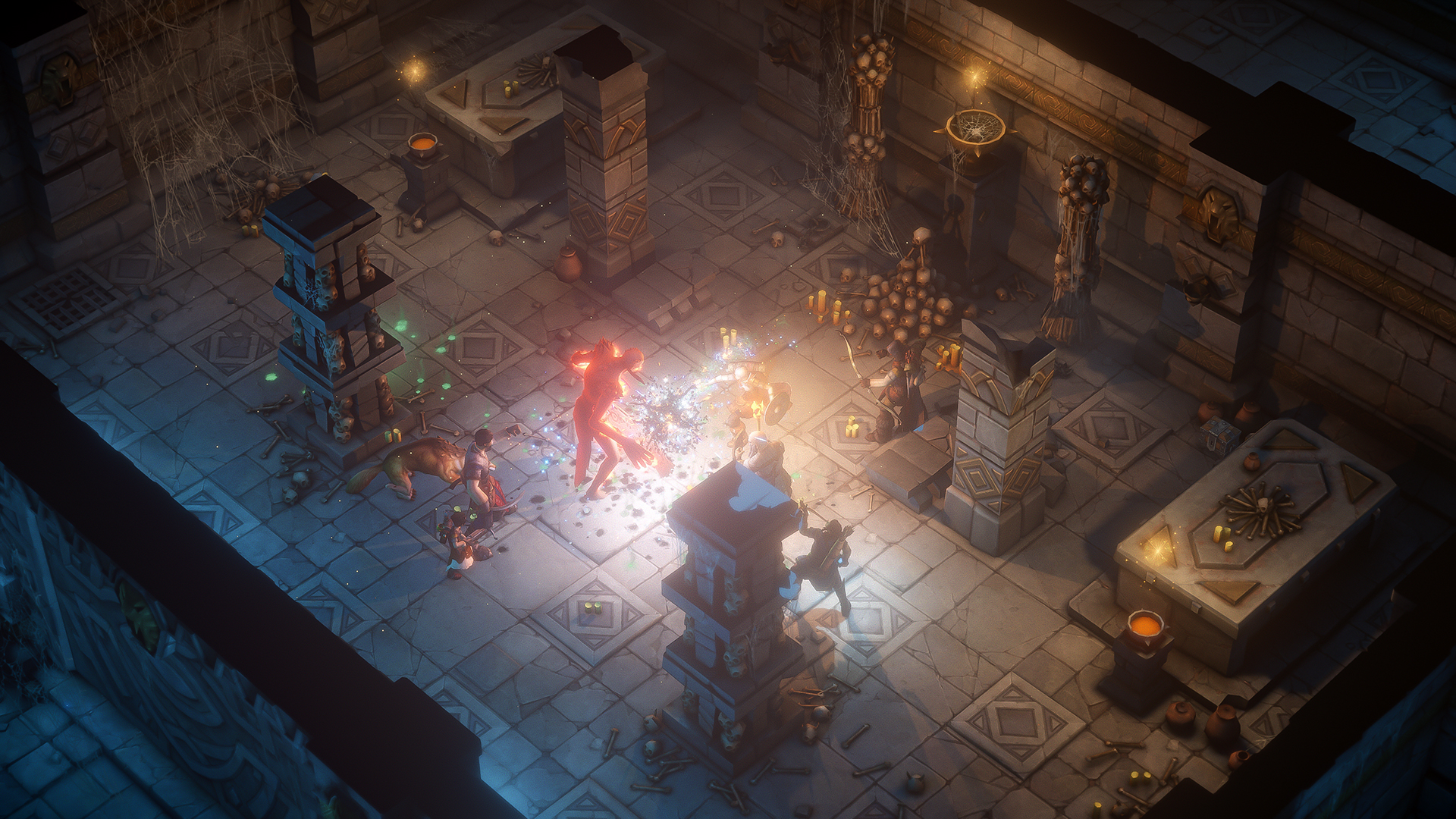
Most RPGs have a similar "structure" that anyone who has put a large amount of time into them will be familiar with. The
art of procrastination in an RPG is something that just becomes a
natural practice with enough time into the genre. It is taken for
granted that, in any given RPG, a player will complete as much side
content as they can, before naturally moving on to the next area or
bit of the main story, rinse and repeat until the game has completed.
Anyone who has played a Bethesda game will intimately know the
feeling of ignoring the main story for dozens or in some cases
hundreds of hours until the game has simply run out of content to
complete. This has always led to the classic criticism that it makes
no sense to ignore a world-ending threat to fuck around with side
content for dozens of hours. To some extent this is a fair
point, and I'm never confused when someone says it stops them from
really getting into RPGs.
Even
back to the father of the modern CRPG with the first Fallout
game,
there have been attempts to try and make considerations for this
procrastination. Pretty famously, Fallout
features
an obvious timer, as well as a hidden system of timers that determine
the fate of some of the towns in the game. Yet even this early on
most of these hidden timers were outright removed or nerfed by the
1.1 patch of Fallout.
Fallout
2
effectively
did away with the concept entirely, save for a token time limit of 13
years. RPGs in general do not tie a failure state to procrastination,
instead only opting sometimes for certain quests being timed or
sequenced in ways to incentivize
completing
them quickly. When there are failure states they're typically only for
a specific section of the game, such as in Tyranny's
Act 1. There are certainly a scattershot of RPGs that have
experimented with their structure, such as Persona
5,
which focused heavily on time management, and offered clear time
limits to complete each section of the game. Certainly there are
other games that feature these time limits, but none that I have
played quite match Kingmaker.
Kingmaker
has,
especially among CRPGs, an incredibly unique structure. CRPGs often
have a rough calendar system, mostly as a fun thing to track how long
the adventure has lasted, and most often measured in weeks to months.
Kingmaker
spans
multiple years.
With very minimal time skips, you control the actions you take for
nearly every day of over four years of in-game time. Even further,
the game is structured loosely into acts, with the bulk of these acts
featuring time limits that will cause your dear kingdom to collapse
should you neglect them. These timers are measured in multiple
months, but at the same time Kingmaker
features
an ocean of side content, optional exploration, and (as will be
discussed more in-depth later) a whole system of management for your
kingdom. I have often seen even longtime CRPG fans attempt to play
Kingmaker and
drop it outright due to these timers. I can understand why. The game
can easily take well over a hundred hours to complete, and spending
much of that time stressed out about scheduling can be extremely
daunting. Again, people are trained by years upon years of RPG
structure to focus on the side content before moving on to
progressing the critical path. These time limits don't really allow
for that, but I believe understanding how these limits work actually
reveals how much agency is really afforded to the player here.
Commonplace
advice for those looking to really get into the game is to focus on
the main story content first, as after completing the main content of
most acts, the player is given whatever time is left in the act to
focus on side-content and kingdom management. This certainly can help
cut down on the stress, and I don't really
have
a problem with this advice. However, I think it ignores what the
system is going for. Kingmaker operates
in roughly three "phases." First, the main story of each
act. Usually this is comprised of an inciting incident of some
disaster striking the kingdom, following up on leads to find the
source, and a long capstone quest that ties the act together and
finishes the main story for that act. Secondly, the phase of
exploration and adventure. The bulk of time here is spent exploring
the map and engaging in side-content. The game features a massive
world map, with the vast majority of it having to be explored
manually. This is also when almost all of the game's companion
content will occur. The third and final phase is that of kingdom
management. Placing buildings, assigning advisors to posts and
missions, claiming territory, solving whatever problems and decisions
crop up, receiving gifts from the various artisans in your kingdom,
all of this occurs in this phase.
Following
the normally given advice, one might find the flow of their game
going from main quest to exploration and back again, with the kingdom
management sprinkled in as needed. This works perfectly fine, but I
find Kingmaker is at its best when you engage in the balancing act by doing everything a little bit at a time. The more you neglect
any one phase, the harder the others will be in the long run. Simply
rush the main quest and you'll constantly be met with interesting
side content you don't allow yourself to engage in naturally. Not to
mention all the gear and levels you could have acquired to make the
other phases go smoother. Neglect kingdom management, and you'll fall
behind on upkeep and can fall into the cycle of "catch-up"
trying to deal with problems that could have been avoided had you
stayed on top of it in the first place. Neglecting the main quest is obviously dangerous, causing a game over should your time
run out.
When you realize how these phases pan out, it then becomes engaging to
find your own balance of time. Once you find what is satisfactory for
you, you might just realize how much freedom is allotted to you. You
have plenty of things to keep track of, and a large over-arching goal
each act, but as long as you make efficient use of your time, you
genuinely have so much freedom to alter the flow of your own game how
you like. Many people find themselves stuck near the end of the act,
essentially doing paperwork for weeks on end, because they've
procrastinated management for so long. Perhaps the game could tighten
up some of these phases more (and I will never make the argument that
Owlcat games don't have bloat and pacing problems because they most
definitely do), but if you engage with it enough the system strikes
an honestly addicting balance of complete freedom and forward
momentum that few RPGs do.
Strike
that, I have never played another RPG that feels quite like this.
Even Owlcat's later games, despite arguably refining each individual
phase greatly, never have quite the same flow as Kingmaker,
mostly (with a few exceptions) on account of the lack of timers. This is
not to say their other games are worse off for the change, but it
does without a doubt leave Kingmaker's
blend
feeling
totally unique. It's one of the most identifiable traits of the game,
and a major reason I never quite understand when I see people convey
the sentiment that "if you've already played Wrath
of the Righteous
you
don't really need to play Kingmaker."
One of the other major reasons is also Kingmaker's
most unique phase of play.
SimKingdom 2018

Any
review or discussion of any depth of this game will discuss the
kingdom management aspect of it. It's simply too big and persistent
to not. It also seems to be the area that makes or breaks this game
for most people, and it's easy to see why. Bioware's Dragon
Age: Inquisition and
Obsidian's Pillars
of Eternity had,
a few years prior, dabbled in similar ideas. All three games feature
timed missions that advisors are sent on, but focus on different
aspects of the concept. The concept of some kind of "stronghold
management" is most certainly not a new concept among CRPGs,
with Baldur's
Gate II prominently
featuring player-owned strongholds depending on the class of the
player character. Even back to the Dungeons
& Dragons rulesets
of the 1970s, there was an expectation that player characters would
eventually "settle down" and run a stronghold of some kind,
eventually retiring their PC. However, I think there is a primary
disconnect with some people with the concept.
A
lot of people play RPGs not to manage a kingdom, but to go on an
adventure. Anything that takes time away from that will inevitably
cause some friction with these people, worsening the more the campaign
or game focuses on it. Kingmaker
to
date is probably the most focus put onto a system like this in any
popular RPG. While I definitely understand the friction this might
cause, (I for one really did not care for Inquisition's
attempt in particular) the management aspect is a driving force of my
love for the game. It's something that really makes Kingmaker
(and
Owlcat games in general) stand out from other CRPGs. I adore how well
the impression of my kingdom
comes across. The advisors I select, the decisions I make, the
buildings I place, where my cities will go, what to build up, all of
it sells a sense of ownership that helps the system stand out above
other attempts. At times yes, it does feel like I'm
literally doing taxes, and god knows there's some balancing issues
(the "No Import Taxes" option is absurdly OP) but there's no
other game that blends these elements of CRPG, city builder, and
management strategy to this degree.
The
worst part of the management is just how much waiting is present in the
system. For reasons that have already been discussed, time is a
valuable resource in Kingmaker.
Most actions you take in the kingdom will take days or weeks of in
game time, during which your advisors will be occupied. They aren't removed from your party however, you just can't send them
on another mission for the moment. These missions in general are not
very disruptive, but where the issues really come about is the stat
rank-up events. Every time an individual kingdom statistic (military,
economy, diplomacy etc.) reaches a new threshold, the player must
initiate a two week long event. The problem? You cannot act during
these events. Time will just skip ahead two weeks, with events and
problems proccing in the background. Why these don't just work the
same as the other projects I really don't know. It requires much more
foresight in time management than anything else in the system, and
can just make the whole thing more tedious than it really should be
whenever they trigger.

Maybe
it's just the way my lizard brain is wired, but I always found
something satisfying watching my little town build into a large city.
Checking the city management menu and seeing every building that I personally
placed just made me so happy. In an ideal world, those buildings
would show up within the physical space of the city during gameplay,
but I also think that would be such a complex task that it doesn't
really hinder my enjoyment of the system. Plus I really do like how
the actual city does change throughout the game, going from a small
village to a sprawling stonework city. I absolutely adore how the
main square of the city will even differ based on your alignment as
ruler. It really sells the feeling that your personality as a ruler is cultivating a totally different style of kingdom.
In
my own play-through I began as the classic selfishly Chaotic Neutral
archetype, never doing anything that didn't immediately help myself.
The town square of my capital prominently featured statues of the
Fey, beings representative of that Chaotic Neutral alignment. Over time this naturally shifted
to helping my companions far more. I don't fully know when it
happened, but eventually, my character's motivations shifted to doing whatever it took to keep
the kingdom happy and free. As my character moved along the path
towards Chaotic Good, so too did my capital, trading out the Fey
statues for a small carnival-like gathering right in the middle of
town square. It was such a small moment, but to see my character's
internal growth and change be reflected by the world, even in a small
way, felt so satisfyingly cathartic.
This
is the kind of thing RPGs can do that no other genre really can. It's
the kind of thing that makes long tabletop games so memorable. These moments are what Owlcat games are built on. This is why,
while to an extent I can understand disappointment or frustration
with the kingdom part of the game, I can never get behind the
sentiment that it didn't greatly add to Kingmaker
in
ways that other games have tried but always come up short. Management
systems have become Owlcat's house style as much as Larian's humor
and environmental interactions have. Maybe even more considering how
much of their games are built around the systems.
Rulesets and Balance: or "Why Does an Owlbear Have 21 AC?

Pathfinder rules
are another big sticking point for a lot of people. It is, in a word,
overwhelming. All the little aspects of combat, the differences in
the way the real-time and turn-based systems work, pre-buffing, the
massive number of options in character building, and the complete
lack of tutorials explaining these things leads to a seemingly
insurmountable learning curve. You will inevitably, 80+ hours into
the game, think to yourself "THAT'S how that works??"
multiple times. To be sure, that can be a profoundly frustrating experience. At the same time there's a special kind of feeling there,
some specific kind of fun that comes from learning a system over
dozens of hours of trial and error. It's not a feeling you often come
across. This isn't an excuse for the way the game telegraphs (or does
fuckall to) these systems, just to say that on some level, if you're
anything like me, there is some fun to be had in that frustration.
It's
beyond the scope of this review honestly, but Pathfinder
1e
specifically was just
designed differently than something like 5th Edition D&D.
Pathfinder
was
born out of unease from the direction Dungeons
& Dragons
was
headed at the tail end of 3.5e, both as a game and as a brand.
Paizo's intention was always to take 3.5e of D&D,
which is already a famously dense and complex rule-set, and to expand
upon it further. It appealed to people who had been playing 3.5e for
going on five years and just wanted more. They didn't want to
reinvent the wheel, they just wanted more for what they already
loved.
Kingmaker
attempts
to take all the crunchy, dense, and complex rules and math of the
Pathfinder
system
and adapt it to a video game. This in itself is a laudable goal and
is another thing that has really made this game and its sequel stand
out among a lot of the “lighter” CRPGs that have grown popular.
There’s a lot to love here from that adaptation! The game is
absolutely chock full of classes, races, weapon types, spells,
abilities, sub-classes, multi-classes, prestige classes, and the list
goes on and on and on.
Kingmaker’s
build paths are an endless rabbit hole to the center of the planet.
Hell for some those builds are the game. There are people who spend
hours plotting out the perfect build, play a dozen or so hours, and
restart all over again. Maybe they even just run them through the
rogue-like DLC. Or they make mercenaries, or mods to respec
companions, or any number of things to dump hundreds of hours into a
stat screen. The system is daunting there is no doubt. But it can be
learned. And once it is learned, an entire new sandbox of
possibilities is opened up to the player, and that is one of the most
rewarding feelings you can have in a game like this.

Unfortunately,
the system itself is just one half of the gameplay here. I would love
nothing more than to praise the depth of the systems at play here and
move on to talk about something else, but sadly one of Owlcat’s
biggest weaknesses has to be addressed. To some degree, all three of
their current games suffer from balancing woes and subpar
encounter design. Kingmaker’s
specific sins are just the absurd number of fights you’ll be going
through, and some of the insane number bloat the game has. Let’s
look at the humble Owlbear for a moment.
Owlbears
are one of Kingmaker’s
most common enemy types, appearing throughout the game in different
variations. In Pathfinder’s
1st edition ruleset, an Owlbear is a rather dangerous animal that
usually travels in packs of up to eight. They feature an Armor Class
of 15, an average hp of 47, and a +8 to their attack rolls, two 1d6+4
claw attacks, and a 1d6+4 bite attack. Kingmaker
must
have put something in the fucking water supply because the humble yet
formidable Owlbear has been bulking up. An armor class of 21, 147
hit points,
+22
to attack rolls,
a claw attack of 1d6+18,
a bite of 1d8+18, and
three attacks per round. Oh and a whole load of combat feats! Instead
of packs of at most eight, the game will at times have you fight wave
after wave of these beasts. Again, this is just the base variant of
ONE enemy type.
Yes,
CRPG enemy AI cannot have the strategy and flexibility of an actual DM. They
cannot go “the party is killing these enemies too fast, I need to
bump up their stats!” or account for whatever insanely broken build
the player will powergame themselves into. In some form, you do need
to buff some enemies for them to have a chance. But this is where the
second issue pops up. Throughout the long adventure, a player will
fight far too many mindless “trash” encounters. Owlcat can
make
interesting, engaging encounters, I’ve seen it done before. But
probably upwards of 80% of combat in this game is just smacking these
overturned enemies until they die. God help you if you play
exclusively in turn-based mode. This all comes to a head in the
endgame dungeon; The House at the End of Time. This dungeon is the
stuff of nightmares, and the epitome of all the problematic game
design decisions of Kingmaker’s
combat. A large dungeon, arbitrarily doubled in length by a whole
“dimension swapping” mechanic, where the player is constantly
hounded by encounter after encounter of overtuned, status spamming
enemies. It goes far too long without any real interesting encounter
design. I have seen no small number of people devote over a hundred
hours to the game, and then just drop it right before the finish line
in this very dungeon.
So
as much as I’d love to sit here and sing the praises of the
excellent adaptation of Pathfinder’s
ruleset, it
would be a misrepresentation to
ignore the very real problems the game’s combat has. Yet it
would be just as much of a misrepresentation
if I didn’t say that, save for that one dungeon from hell, I
genuinely enjoyed my time with the systems and combat. Building my
party was consistently engaging and the gearing was always fun. That
intrinsic deep enjoyment of delving into a dungeon, finding some
weird creature, slaying it, and taking the spoils for myself is just
as strong as the rest of the genre.
Pathfinder: The Short Story Collection

Story
in CRPGs might just be the most divisive aspect of the entire genre.
Even tent-poles like Planescape: Torment or
Disco Elysium will
have a strong contingent that just despise the writing and story of
them. Games that might not have the most proficient prose might still have some unique tone, or characters, or standout moments that still allow it to connect with many. Kingmaker might not
have the philosophical depth of a Planescape
or the prose of a Disco Elysium,
but what it most certainly does have is a degree of ownership
unmatched by most other CRPGs.
The
actual structure of the story is rather interesting. Much of it is
adapted from the 2010 Pathfinder adventure path of the same
name. Adventure paths are “sections” of larger Pathfinder
adventures, with each “sections” published around once a month.
Within Kingmaker this leads to an almost episodic style of
storytelling. Yes, there is a somewhat overarching main plot running
in the background, but for most of the game it just serves as a
framework to tie together all the stories of the individual acts.
Each act serves a mostly self contained story, and usually revolve
around solving an engaging mystery related to various problems
arising in the kingdom. Each of these stories have a totally
different feeling to one another. One act might revolve around a town
of people who have vanished, and the mystery of who or what could be
behind it. The next might see the player and their party dealing with
tribes of barbarians, or an army of trolls, or a rival neighboring
kingdom, or who knows! Part of what makes the story so engaging is
that it offers such a fun variety of scenarios. Each act feels fresh
and that just helps so much in such a long game.
Companions don’t have as much to them as some
other games (especially later Owlcat games) but what they do have is consistently great. Companions all have vibrant personalities and engaging story-lines, and there's plenty of cute romances for those that want them. Rather uniquely, Kingmaker even offers a throuple romance with the companions Octavia and Regongar. Party members having romantic relationships outside of the player are already unique. To write romances that are engaging for not just two characters separately, but also together is practically unheard of in a major RPG.

This
can often lead to another trait that would become inherent to every
Owlcat game thus far; pacing problems. Kingmaker’s case is
rather interesting however, because if you’ll remember from
earlier, the pace of the game is pretty much determined by the
player. You’re often allowed to bum-rush the main plot in maybe a
dozen hours or so, only to spend far longer than that meandering
around waiting for a new story to trigger. Maybe you’ve waited
until the last minute to finish an act's main story, which then will
immediately lead you right into a whole new story-line without time
to breath. The freedom the game gives you in your own pacing is so
worthwhile, but when combined with a relatively unstructured main
plot, it most certainly will lead to inconsistent pacing at some
point in the incredibly long tale. Even then, there’s another layer
of overarching story that helps tie even that uneven pacing back into
the rest of the game.
The
most impressive part of Kingmaker, and what Owlcat will go on
to simply excel at like no other, is how effectively every aspect of
the game I’ve previously discussed ties back together to form an
entire narrative unto itself. The game opens with your character,
entirely defined by you, just being some nobody about to set off on
an adventure with and against a whole gaggle of other nobodies. By
the end that same character will have created an entire kingdom, and
changed the shape of the region forever. Every step of that tale is
yours to define. The big-ticket events of the story will always occur
yes, but you define what kind of character you’ll play, what kind
of ruler you will be, and what shape your kingdom will take.
Kingmaker gives you that authority and ownership that so many
other RPGs will only pay lip-service to. Someone
might say “well that’s just how CRPGs should work” to which I
would emphatically yell “YES!” It’s the strength of an CRPG to
give you the tools and freedom to define your character more so than
anything else save for the tabletop RPGs they draw from. But Owlcat
does it with just so many systems and on a completely unique
scale. This is what lets me look past so many of the pacing problems,
or bugs, or unbalanced combat, or poorly telegraphed mechanics,
because simply put, no one else is making games like this. If CRPGs
were partly created to show how video games can create the same kind of storytelling that TTRPGs allow for, then Kingmaker
might just be one of the most successful I’ve yet seen.
The Other Stuff

The
hardest part of Kingmaker to make peace with is just how buggy
it often is. Turn-based combat will often hang, requiring you to swap
between real-time with pause mode and back, often losing surprise
rounds, becoming flatfooted, or losing followup attacks due to the
bug. Plenty of quests have bugged steps, misfiring timers, or will
just plain break. Many items, effects, and spells will just not work
properly. This just becomes more and more frustrating as the game
goes on and the bugs become more prevalent. Maybe it's
expected with how massive this game is, but that doesn't make it any
less frustrating. It has improved since launch by an
immeasurable degree, but Owlcat losing the rights to the game when
they became independent in 2019 has pretty much ensured the game will
never be at the place it could be polish wise. That’s all just with
the PC version, on consoles? Forget it.
The
technical state is a real shame too, because sometimes it
negatively impacts the art of the game. And damn, let me tell you
there’s some good art in this game. Kingmaker
opts for 3D environments with a locked camera angle. I do prefer in
later Owlcat games when they unlock the camera angles, and the
fidelity is certainly not the best for a 2018 game, but all of that is
made up for with such evocative art-direction. The world of Kingmaker
feels like it stepped right off the pages of a TTRPG source book.
It’s simply gorgeous exploring these lush wilderness maps, or the
strange beauty of the First World, or even the decaying depths of
some forgotten tomb. It’s evocative and wraps you in a comforting
fantasy blanket, drawing you on to see what else is out there to
discover.
The
sound and music stand right alongside the environments in pulling you
in to the game. Much of the music is serene and beautiful fantasy
music, but it isn’t afraid to throw out some really interesting
instrumentations too. Each area of the world has it’s own musical
texture to it, and I never once found myself getting tired of any
track in the game. Sound design is one thing that usually goes
unnoticed unless it stands out negatively, but every little footstep
noise, monster shout, environmental soundscape, everything just
coalesces so nicely to just really sell that perfect fantasy
adventure feeling.
Voice
acting in CRPGs is always a difficult topic. For most of the genre’s
history, voice acting has been a great bonus when its there, but
there was never the expectation of it always being there. Kingmaker
however came at a time when the idea of full voice acting was
becoming much more common in these games. Pillars of Eternity II:
Deadfire, Divinity: Original Sin both, and before long the
“final cut” of Disco Elysium would all feature full voice
acting. Now in the age of Baldur’s Gate 3, a lack of full
voice acting alone can turn people off from a game. In Kingmaker
on the other hand, a vast majority of dialogue remains unvoiced. Its
a personal thing for sure, but It never truly bothered me. The voice
acting was quality enough and used well enough to elevate the game
for me when it was there, but I never felt frustrated when it wasn’t
there. Unlike later Owlcat games however, the voices here are not as
consistent in quality. Most are perfectly fine, and many rise above
to be excellent! But it certainly is clear not all of the voice
actors are delivering equal performances for whatever reason, and
that can be rather distracting at times.
But is the game good?
Well
yeah. It’s better than good, it’s honestly a miracle. To borrow a
turn of phrase from Bethesda’s Pete Hines about Starfield,
Kingmaker is irresponsibly large. Someone somewhere should
have stopped the game before it reached this scale. Damn am I glad no
one did. It's engaging, buggy, complex, uneven, and above all deeply
compelling. The Kickstarter CRPG boom of the 2010’s saw a new
golden age of games trying to make something just as beloved as the
first golden age of Fallout and the
Infinity Engine games while putting a new spin on the genre to stand
out. Kingmaker is no different. It captures what makes
CRPGs so unique, while also emulating the strengths of TTRPGs more
than any game had in a very long time.
The
level of freedom, of authority, of ownership
over your own character, your kingdom, and your story triumph over
the flaws to create something truly memorable. There
will always be those sticking points of the bugs, the pacing, the
balance, the management, and whatever else. Those will be the things
that determine if someone drops the game early, or sticks it out to
see one of the most unique and compelling games the genre has to
offer.
I
think you can guess where I fall.
Score: 9.0/10
DLC Round-up
The Wildcards
Varnhold's Lot
Varnhold’s
Lot was a rather pleasant
surprise. Taking place during the main game, the story ties into the events of one of the mid-game’s acts with a whole newly created player character. Because of this, it can serve as
a really nice change of pace from the main game, or just an easy way
to get some more out of Kingmaker without having to commit to a whole
new run. The two main companions, Maegar Varn and Cephal, are well
established and have great banter between each other. It’s a much
more linear adventure, but with a very Baludr’s Gate I
style area design. This is most apparent with the City of
Hollow Eyes map with all of its side content spread around. It even
offers a rather sweet optional romance with Maegar, changing some of
his dialogue in the main game to reflect it. The last dungeon is a
doozy and really reminds me of the classic DLC dungeons of Durlag's
Tower and Watcher's Keep. Solid all around. Really
holding it back however, are the absolute deadweight "companions" who should be dumped immediately. I think it is to the strength of
the DLC that it focuses so much on the core trio, but it would also
be nice if the pre-built extra party members were useful in any way, shape, or form. Effects on the main game are very light too outside of
the romance, but for its position as a side adventure, it stays pretty
damn fun.
Beneath the Stolen Lands
Beneath
the Stolen Lands is both a
game-long dungeon delve and a rogue-like dungeon crawl depending on
whether you play it during the main game, or from the main menu with
a custom party. Personally, I’m not someone who cares to play this
game without the greater context of the main game or even Varnhold’s
Lot, so the rogue-like idea does
not do much to interest me. And as part of the main game, the dungeon
present here doesn’t have the tight design of classic DLC dungeons
of old, and so just ends up becoming a side thing to do while killing
time between acts of the main story. There’s some good gear here
and the final boss is cool and all, but the core dungeon just isn’t
interesting enough to draw me into it.
Notes:
All screenshots used are my own or from the Steam store page. Header is
from the GOG banner. Trailer from GameSpot because Owlcat posted the
German launch trailer instead of the English one. The portrait I used
in-game is from the
very talented Šárka Claina Štvrtňová.

Comments
Post a Comment